 If you have a pipe or sewer line that keeps getting clogged, you know how frustrating it can be. This situation can lead to other nasty problems, too, including mold growth, pest infestations, and water damage.
Fortunately, there are ways to remove even the most stubborn of plumbing obstructions. And one of the most effective is hydro jetting.
To get started, here are a few key hydro jetting takeaways:
- This process begins with a crucial step: the in-pipe camera inspection.
- Hydro jetting clears out pipes with high-pressure water streams — streams that are up to 4,000 pounds per square inch (PSI), in fact.
- Hydro jetting is more effective than snaking for grease, sludge, and tree roots, and it’s safer and more eco-friendly than chemical drain cleaners.
What Is Hydro Jetting?
Hydro jetting is an affordable, state-of-the-art plumbing technique for eliminating tough blockages in drains, pipes, and sewer lines.
As its name suggests, the process involves blasting those obstructions away with a special hose.
Hydro jets vary in size. A portable electric unit might be shorter than 3 feet and weigh around 140 pounds. An industrial hydro jet, meanwhile, could weigh well over a ton.
Whatever a hydro jet’s size, each of these machines has the same major components. There’s an engine or motor, a pump, a high-pressure hose (which is often mounted on a reel), and a number of specialized nozzles.
Also, some hydro jets connect to a water source, while others come with their own water tank.
How Hydro Jetting Works, Step by Step
 Despite its high-tech nature, hydro jetting is relatively simple and straightforward.
It goes like this:
- A plumber inserts a small camera into the blocked pipe. Thus, this professional can discover exactly where the obstruction is located, how large it is, and what it’s made of.
- The plumber connects the hydro jet to an access point such as an outdoor cleanout.
- The technician feeds the hose into the pipe until it reaches the blockage. In many cases, the tiny camera helps this person locate the obstruction. And, using the camera, the plumber can confirm that the nozzles are facing the right way.
- The high-pressure water stream shoots through the nozzle and blasts the clog. Whether that blockage consists of grease, minerals, sludge, or other materials, the multidirectional stream will quickly obliterate it.
- The plumber maneuvers the hose so that the pipe walls are fully cleaned and every bit of debris is removed.
- The water is turned off, and the hose is pulled out of the pipe.
- The little camera goes into the pipe one last time. That way, the plumber can verify that the obstructions are completely gone and the pipe is pristine.
Benefits of Hydro Jetting
Hydro jetting offers various advantages, including the following:
- It thoroughly cleans pipes and pipe walls, something that can be difficult to do otherwise.
- It prevents — or at least delays — new pipe clogs.
- It’s versatile, useful in both residential and commercial settings.
- It’s friendly to the environment, involving no harsh chemicals.
Risks and Drawbacks to Consider
As with any maintenance technique, however, hydro jetting might not be right for all property owners.
Here, then, are some potential complications to weigh before scheduling a hydro jetting session:
- It can be less effective for — and might even harm — pipes that are brittle, collapsed, weak, or otherwise damaged.
- It has a higher upfront cost than snaking and some other pipe-cleaning methods.
- At times, it can be noisy and messy.
- It must be handled by licensed professionals; DIY hydro jetting isn’t safe.
When Hydro Jetting Is Worth It
For sure, hydro jetting works well in all kinds of settings.
But it’s especially helpful in these scenarios:
- When clogs keep occurring despite repeated snaking attempts
- When a plumbing system is used especially often, as with a large office complex or a public restroom
- Whenever there’s a heavy buildup of grease, as happens in many restaurants and home kitchens
- When severe blockages occur, such as tree roots intruding into sewer lines
- Whenever preventative maintenance may be required, like in an older building or a home with hard water
How to Prepare for Hydro Jetting
Before the plumber gets to your home or business, you should clear access to your cleanouts.
It’s also a good idea to move furnishings and other items out of the way. You don’t want them to get wet or dirty. You could cover the area with a canvas or drop cloth as well.
In addition, you might want to have a few questions ready for your plumber.
For instance, maybe you’d ask:
- Do you guarantee your work?
- Can I look at the camera footage?
- What’s the PSI of your machine?
- How long will will hydro jetting keep pipes clean?
Fort Myers Benjamin Franklin: Ready, Set, Hydro Jet!
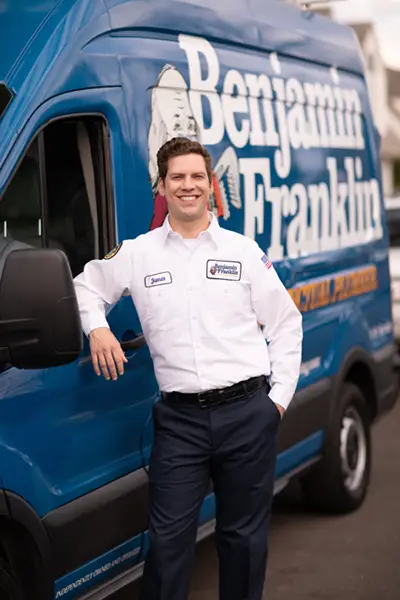 Finding the right plumber for your hydro jetting is essential. After all, if a hydro jet isn’t handled with expertise, pipe damage and property damage could easily occur.
With a skilled pro, your pipe will be as clean as could be — and you’ll get your money’s worth. Furthermore, to protect yourself legally and financially, your plumber must be fully insured and licensed.
For effective hydro jetting, Fort Myers Benjamin Franklin is an excellent choice. Our punctual plumbers are meticulous, and they operate hydro jets with total control and great accuracy.
In short, our team members are dedicated to outstanding customer service and to delivering the best possible results every single time.
If your Fort Myers home or workplace has a slow drain or a sink that keeps backing up, please call us to discuss your options. Remember: Benjamin Franklin Plumbing is the Punctual Plumber, and we’d be happy to clear out your pipes anytime.