 How much do you think, on average, water heating accounts for a home’s total energy usage? The answer might surprise you: approximately 18%!
To keep those utility bills down, then, it’s crucial to find the right water heating system.
Of course, when you’re choosing a water heater, there are factors to weigh besides energy expenses. For instance:
- How much space do you have for your heater?
- How much hot water does your household need?
- Which heating system would last the longest?
- Which would provide you with the most convenience and comfort?
Basically, when it comes to water heaters, you have two major options: the tank kind and the tankless kind.
Let’s examine how these two heaters work and consider their unique pros and cons.
How Tank Water Heaters Work (The Classic Style)
 The traditional tank water heater is powered by gas or electricity. (Some models, however, are hybrid.)
This machine heats water inside its tank, which can hold between 30 and 80 gallons. Moreover, it can maintain a consistent water temperature even when it’s not in use.
But how exactly does this machine function? Well, here’s the basic process:
- Cold water enters the bottom of the insulated tank by flowing through a dip tube.
- An electric heating element or gas flame raises the water’s temperature, causing it to rise to the top of the tank.
- A thermostat regulates the temperature of the warm water for as long as it stays in the tank.
- When someone turns on a faucet or shower head, warm water leaves the tank from the top.
- To replace the water that flows out, cold water enters the heater from the bottom, starting the process all over again.
How Tankless Water Heaters Work (The Modern Upgrade)
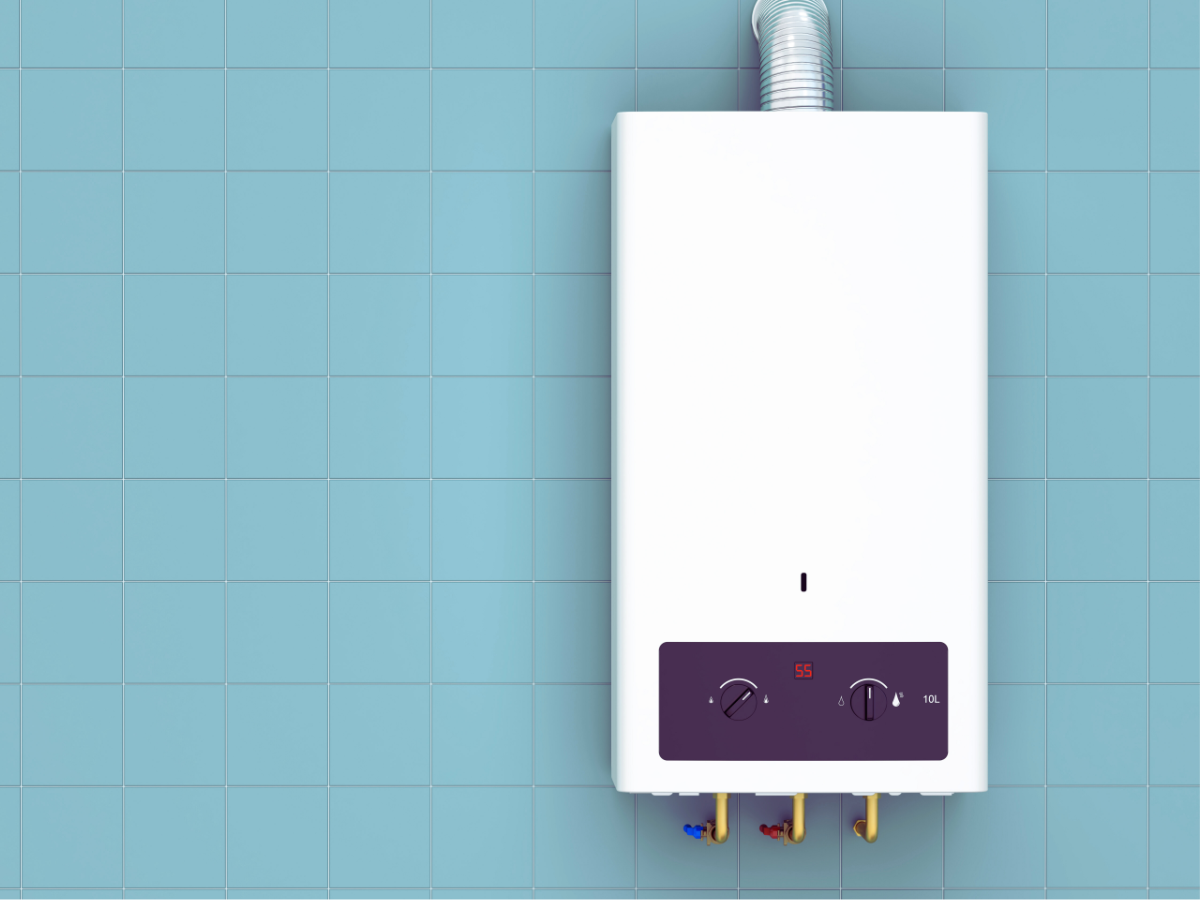 Since tankless water heaters lack tanks, they don’t store any water. Instead, they heat water as it’s needed.
That is, when someone turns on a hot water tap, cold water enters this machine. And, once it’s inside, the flowing water triggers sensors that activate heat exchangers.
Heat exchangers are metal coils that transfer heat from the machine’s burners to the water.
As long as the hot water tap remains on, water will keep flowing through this heater. Therefore, a tankless heater would likely be a better choice for a larger household. It’s also good for a home where water’s only used occasionally, like a vacation house.
Note that electric tankless heaters are generally more energy-efficient. Gas-powered tankless heaters, however, tend to have higher flow rate capacities (which are measured in gallons per minute, or GPM).
Now let’s take a closer look at the raging tank heaters vs. tankless heaters debate.
Energy Efficiency Breakdown
For starters, tankless water heaters require less energy — as much as 34% less energy, to be precise.
One reason tank heaters are less energy-efficient is standby loss. As the name suggests, standby loss is when heat escapes from a container — in this case, the water tank. Naturally, it takes extra energy to reheat any water that’s affected by standby loss.
Cost Analysis: Upfront Vs. Long-Term
Tank heaters are usually cheaper upfront. It costs about $500 to $1,500 to install a tank heater and about $1,500 to $3,500 to install a tankless heater.
Replacing a tank heater is easy and affordable as well.
On the other hand, a tankless heater could save you money over the long haul. For example, it might qualify you for special tax credits and rebates. And again, it should lower your utilities expenses.
Space and Aesthetic Considerations
To accommodate a tank heater, your home must have extra space: A basement or spare closet would be ideal.
But maybe you live in a condo, modern home, or other dwelling with limited space. In that case, a compact, wall-mounted tankless heater would probably make sense.
Lifespan and Maintenance
 You could expect a tank system to last about 10 to 15 years with proper maintenance. Well-maintained tankless systems, meanwhile, can have lifespans exceeding 20 years.
What does water heater maintenance entail, though?
A tank system requires an annual flushing. That means draining the machine, cleaning out all of the sediment and debris, and then refilling it.
Each year, you should also check a tank heater’s anode rod. This metallic rod attracts corrosion; by doing so, it keeps the rest of the heater from getting corroded. Once the anode rod is worn down to its core — or once it’s covered in a buildup you can’t easily remove — it’s time to replace it.
For its part, a tankless water heater needs descaling every year or two — especially in areas with hard water. Descaling involves circulating a special cleaning solution through the entire machine. That liquid solution will clear out mineral buildup and prevent damage.
Pro tip: If you install a water softener in your home, you could extend the lifespan of your water heater.
Environmental Impact
Which type of water heater is friendlier to the environment? The answer’s clear: A tankless system will reduce your household’s carbon footprint and use less energy.
A tankless water heater will likewise boost your home’s ENERGY STAR rating and overall sustainability. And sustainable homes often have higher property values as well as fewer indoor toxins.
Common Myths Debunked
In all of this, remember that tank heaters and tankless heaters are both reliable and useful machines. Different heaters simply work better for different people.
Therefore, when you hear sweeping generalizations about a certain water heater, realize that it might not be accurate. For instance, the statement that “tankless is always better” isn’t true.
Likewise, the notion that “tank systems are outdated” isn’t correct — especially when it comes to hybrid models. And the idea that “tankless water takes too long” only holds true when a heater is sized improperly.
Final Verdict: Which One’s Right for You?
In the end, picking the right water heater is both a practical and a personal decision.
To make this choice, you must think about various factors: the size of your household, your upfront budget, your annual household budget, your available space, your feelings about the environment, and so on.
If you carefully review the list of pros and cons above, the right decision should soon be apparent. And, if you’d like, you could always call an expert plumber for additional info and advice.
Expert Tankless Water Heater Services in Fort Myers
 Are you ready for a new water heater now? Are you especially interested in the tankless variety?
If so, we at Benjamin Franklin Plumbing could help. Our punctual plumbers service homes in Fort Myers and all nearby areas. And we’re famous for our attentive service and truly excellent results.
Indeed, you could call us anytime to schedule a free consultation or water heater assessment. That way, you could start enjoying your new heater as soon as possible. Yes, it might be a tankless job, but we’re happy to do it!